
By: Amy Dawson, PharmD and Sarah Raake, PharmD, MSEd, BCACP, LDE
Bad Timing
Sullivan University College of Pharmacy and Health Sciences (SUCOPHS) offers a 3-year accelerated Doctor of Pharmacy degree. The year-round curriculum focuses the first two years on didactic and introductory experiential education and the third year on advanced experiential learning. The condensed schedule (eliminating summer breaks in favor of short, quarterly breaks) can be both a blessing and a curse. When a pivotal, time-sensitive issue arose recently, the pinch of the accelerated nature was felt even more acutely, and it was left to a few creative individuals to take the resources at hand and make the best out of a tough situation.
In February 2023 when the NAPLEX results were released, pass rates had declined nationally and dropped significantly for this College. The next graduating class was only months from taking their NAPLEX, so the question arose; what (if anything) could be done for them? Faculty felt something was needed, but like many institutions, faculty ranks were lean and time was short.
Developing and implementing a novel NAPLEX review program
With the help of educational experts within the College, SUCOPHS adapted commercially-available NAPLEX review materials, supplemented with faculty-led active learning to create a bolus, 3-day intensive “NAPLEX Boot Camp” followed by basal checkpoints staggered every 1-2 weeks until graduation.
The bolus + basal review approach was chosen to incorporate two educational theories grounded in research: high-impact tutoring and spaced learning. High-impact tutoring is defined as three or more tutoring sessions per week or intensive, week-long small group learning sessions.1 Because both time and human capital were rate limiting factors, the goal of the boot camp was to cover the most lucrative content possible in the shortest amount of time, intertwining both passive and active learning. An example set-up for one day of the boot camp is below.
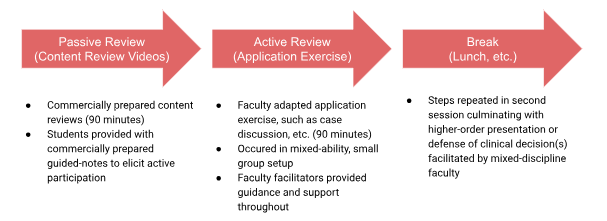
At the conclusion of the bolus portion of the review, all students were brought together for a large-group clinical case defense. Within the culminating activity, faculty from both foundational and clinical sciences were tasked with spring boarding questions and revisiting content pearls from various NAPLEX areas. This mix of faculty provided various contexts from which discussion could be directed (i.e. clinical sciences faculty focusing more on NAPLEX Area 3 while foundational sciences faculty focusing on Area 2) which furthered the strength of the high-impact tutoring model.1
While spaced learning lacks a consistent definition, the theory involves repeated exposure to specific material over a defined period of time.2 Once the boot camp concluded, students had different deliverables and activities to complete independently that revisited the concepts covered in boot camp due at staggered times, thus following the spaced learning framework.2 The table below outlines examples of some of these activities.
| Bolus Element: High impact tutoring | Basal Element: Spaced Learning | |
| Theory basis: | Defined as three or more sessions per week or intensive, week-long small group learning sessions1 | Repeated exposure to material over a defined period of time2 |
| Examples from our NAPLEX Review Program: | 3-day boot camp, culminating in clinical case defense | Required deliverables submitted at staggered points throughout remaining review period, such as: Practice tests through commercial program Student generated assessment item submission Gamified review item submission “Top Drugs” reviews based on items seen in practice tests |
Outcomes and student reported satisfaction
At the conclusion of the intensive bolus review, 35 out of the 36 students in the cohort (97%) completed a survey to evaluate their overall satisfaction with the event and the helpfulness of review materials. Students responded to questions on a Likert scale with 1 (not satisfied/helpful) to 6 (extremely satisfied/helpful). The mean student satisfaction rating was 4.59 while the event’s helpfulness was rated at 4.65. Approximately 50% of the students indicated they would not have studied so intensely if they had not participated in the guided review. Overall, these initial results indicate a positive response to the Boot Camp event. While the ultimate success will not be known until the 2023 NAPLEX pass rates are released, the hope is that this bolus + basal design primed graduates with an intense content review while also providing a means for continued, spaced review that together ultimately strengthened individual NAPLEX preparation.
Reflections from faculty
Overall, anecdotal feedback from faculty was positive regarding the format and flow of the review process. While any chosen approach would have required additional faculty workload, the bolus + basal nature limited the time needed to a few concentrated days for a bolus dose and the basal portion was spread out enough to not feel overwhelming for faculty involved.
“If you had found yourself in this situation, what strategies would you have implemented?”
References:
- Robinson C, Kraft M, Loeb S, Schueler B. EdResearch: Accelerating student learning with high-impact tutoring. “EdResearch for Recovery Design Principles Series.” Published Feb 2021.
- Versteeg M, Hendriks R, Thomas A, Ommering B, Steendijk P. Conceptualising spaced learning in health professions education: A scoping review. Med Educ. 2020;54(3):205-216. doi: 10.1111/medu.14025
Author Bios:
Amy Dawson is a PGY2 oncology resident at UofL Health – UofL Hospital. Educational scholarship interests include adapting didactic teaching methods to clinical precepting and promoting independent learning. In her free time, Amy enjoys baking and running.
Sarah Raake is an associate professor and Director of Instructional Effectiveness at the Sullivan University College of Pharmacy & Health Sciences. Educational scholarship interests include all things didactic curriculum and assessment related. In her free time, Sarah enjoys traveling and spending time with her twin two-year-olds on their farm.
Pulses is a scholarly blog supported by a team of pharmacy educators.
 Pulses
1 Comment