
By: Lauren Robertson, PharmD and Ashlyn Aguiniga, PharmD, BCACP, CDCES
Time is a valuable yet limited resource for pharmacy students. Between exams, rotations, and everyday responsibilities, managing it well can make the difference between success and burnout.
As an incoming pharmacy student, adjusting to a new environment and sudden workload increase felt overwhelming. I struggled to balance assignments, prepare for exams, and manage everyday life. Looking back, I realize those struggles shaped my time management approach today.
This personal struggle isn’t unique. Studies show pharmacy students frequently report difficulty balancing academic load and daily responsibilities, leading to increased stress and reduced academic performance.1,2 One study particularly demonstrates that post-clinical students have better time management skills than pre-clinical students, suggesting skill improvement over time.1
It makes me think: how can educators, preceptors, and mentors provide students with tools to manage their time more effectively? Time management is an essential life skill beyond academics. Early introduction of strategies such as those described below may help students succeed and carry healthy habits throughout their professional and personal lives.
What do we know about Time Management?
Time management is dividing time effectively to maximize productivity.3 It involves prioritizing tasks, creating a schedule, reducing distractions, making time for self-care, and more. Together, these habits may improve workflow, efficiency and support a healthier work-life balance.3
Common Barriers to Time Management
As highlighted in “The Myth, The Science, and The Alternatives to Multitasking,” many believe multitasking helps us accomplish more, but evidence demonstrates the brain can only focus on one cognitive task at once. Multitasking causes the brain to rapidly switch between activities, draining mental energy and lowering productivity.
Procrastination is another time management barrier. It is defined as unnecessarily postponing tasks despite knowing the negative consequences, such as undue stress and missed opportunities.4 Procrastination often comes from a desire to avoid unpleasant tasks, anxiety, or choosing short-term comfort over long-term goals.4
I’ll admit—I used to procrastinate as a student, telling myself, “I have time” or “It’s not due until next week.” Then, before I knew it, the deadline was here, and I’d be up all night trying to finish an assignment I could have started weeks earlier.
Recognizing these barriers is the first step to overcoming them.
Building a Strong Foundation: Strategies for Students
Personally, I love to-do lists and the satisfaction of crossing off items. However, I quickly realized I tended to complete the easy tasks first, while the most important ones remained untouched. That’s when I began exploring time management strategies and came across a blog from Time Doctor, which discussed several tools applicable to pharmacy students.
Students are likely familiar with time blocking – a strategy that involves scheduling chunks of time for specific tasks to build structure into the day. Beyond this common strategy, here are a few that I’ve found practical and applicable in pharmacy education and introduce to first-year pharmacy students:
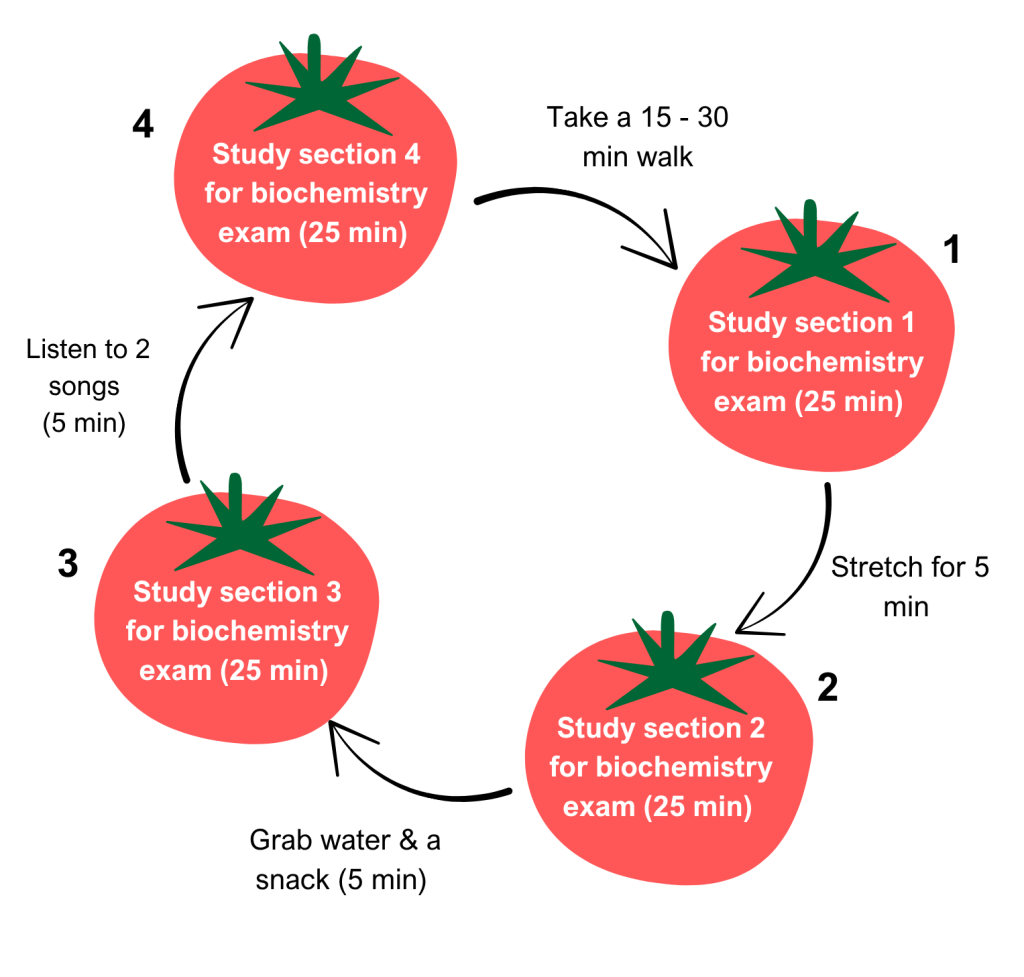
- Pomodoro Technique: Organizes work into 25-minute intervals (“Pomodoros”), separated by short breaks and a longer break after 4 Pomodoros.
- Example:
- Eisenhower Matrix: Organizes tasks into four quadrants:
- Q1: Urgent and important → handle immediately
- Q2: Important but not urgent → schedule
- Q3: Urgent but less important → delegate/automate
- Q4: Neither urgent nor important → eliminate
- Example:
| Q1 Studying for an upcoming exam Handling an unexpected family emergency | Q2 Completing next week’s assignment Meal prepping |
Q3 Responding to group chat messages about a TV show Helping friends with notes when you haven’t sufficiently studied | Q4 Scrolling on social media Binge-watching Netflix |
- Eat That Frog: tackling the most challenging, high-impact task first to build momentum for the day
- Example: A student identifies next week’s drug quiz as their currently most challenging task. Instead of checking emails, the student blocks 30-45 minutes at the start of each morning to study the most difficult medication flashcards first.
Beyond these, students may benefit from exploring additional techniques such as the “2-minute rule,” “Pareto Principle (80/20 rule),” or “Ivy Lee Method,” as finding the most effective strategy(ies) should be an individualized process.
Teaching pharmacy students strategies such as these may help them better divide their time, ultimately, reducing stress and improving academic performance.
I often think of time management as a marathon rather than a sprint. It takes practice and self-awareness. There will be periods of effective management and times when it falls short—but consistency and effort lead to improvement.
What strategies have you seen incorporated into curricula—or used yourself—to support effective time management?
References:
- Zeeman JM, Benksy HP, Minshew LM. Pharmacy student stress and time use in pre-clinical and clinical students. Am J Pharm Educ. 2023;87(5):100073. doi:https://doi.org/10.1016/j.ajpe.2023.100073
- Sansgiry SS, Bhosle M, Sail K. Factors that affect academic performance among pharmacy students. Am J Pharm Educ. 2006;70(5):104. doi: 10.5688/aj7005104
- CFI Team. Time management. Corporate Finance Institute. Published October 26, 2022. https://corporatefinanceinstitute.com/resources/management/time-management-list-tips/
- Cherry K. Procrastination: Why it happens and how to overcome it. Verywell Mind. Updated September 29, 2025. https://www.verywellmind.com/the-psychology-of-procrastination-2795944
Author Bio(s):

Lauren Robertson is a PGY-2 Ambulatory Care Pharmacy Resident at JPS Health Network and an Adjunct Assistant Professor at the University of North Texas System College of Pharmacy. Her educational interests include chronic disease management, leadership, and academia. In her free time, she enjoys binge watching Netflix Tv-shows and spending time with friends and family.
Ashlyn Aguiniga is an Assistant Professor of Pharmacotherapy at the University of North Texas System College of Pharmacy and an Ambulatory Care Pharmacist at UNT Health Clinical Practice Group – Family Medicine. Her educational scholarship interests include classroom innovations, critical thinking, and teaching skills in the affective domain. In her free time, she enjoys spending quality time with her husband, daughter, and dogs as well as trying new restaurants in the Dallas-Fort Worth area and beyond.
Pulses is a scholarly blog supported by a team of pharmacy education scholars.
 Pulses