
By: Daniella Egbujor, PharmD Candidate 2027 and Brittany Long, PharmD, BCACP, CTTS
As pharmacists’ roles and responsibilities continue to expand across practice settings, PharmD programs are seeking new ways to support students’ professional growth, career readiness, and desirability as candidates for residency, fellowship, and the workforce.1 One emerging approach is offering specialized pathways (also known as tracks or concentrations) to students within didactic curricula. These pathways allow students to tailor their education to individual interests.1 It is hoped this will provide valuable opportunities to gain deeper preparation for practice and allow for differentiation amongst other students at the time of graduation.
Why Specialization is Needed:
It is presumed these pathways may enhance student preparedness, professional differentiation, and desirability as candidates for advanced training. By systematically assessing and refining specialized opportunities, pharmacy schools can aim to maximize student value, support career interests, strengthen professional development, and better prepare future pharmacists to meet the evolving needs of the profession. It will be imperative to assess the perspectives of students and stakeholders; do they perceive value in and have a desire for these pathways?
Challenges:
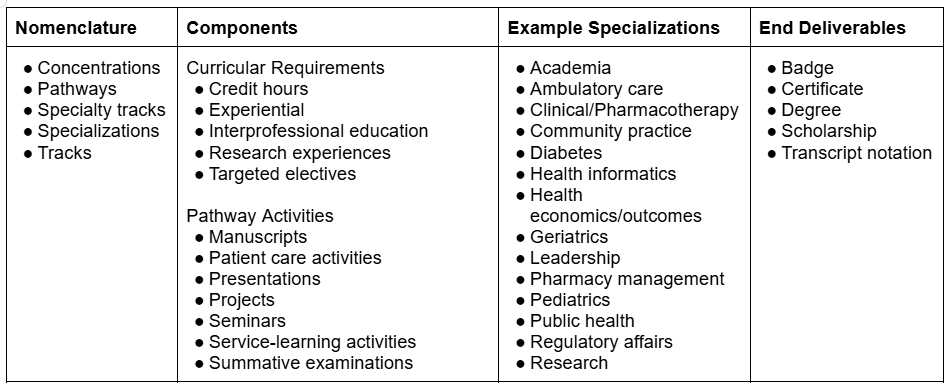
Currently, pathway offerings remain inconsistent. There is no standardization across colleges and schools of pharmacy regarding the nomenclature, structure, requirements, end deliverable, or specialization types offered.1,2 Table 1 highlights variances. This lack of clear consensus could create confusion for students, preceptors, and employers about what the student has accomplished, the rigor, and the value offered by having done so.
Another challenge is the limited availability of these opportunities amongst pharmacy schools. Although specialization options within PharmD curriculums are expanding, a study conducted by Parsons et al. found only 24.6% (16/65) of responding U.S. pharmacy programs currently offer specialty tracks.2 Islam et al. found only 17% (23/132) of programs mentioned pathways such as these on their websites.1 Overall, availability appears limited, leaving many students without opportunities to pursue specialization during the PharmD curriculum. Additionally, institutions face logistical and resource-related barriers, such as limited faculty bandwidth and expertise, insufficient curricular space, need for pathway oversight, and ability to integrate without extending time to degree.2
Table 1:
Characteristics of Currently Offered Specialized Pathways1-3
Call to Action:
While current offerings are limited, Parsons et al. found that of the 49 schools not currently offering tracks, 19 (38.8%) were considering it.2 This demonstrates an interest by pharmacy programs to offer these opportunities to students, and others have echoed this call to do so.4
A first step will be evaluating the desire for, value of, and expected post-graduation impact of these pathways from the perspective of students and outside stakeholders to further support institutional resources needed to bring offerings to fruition.1,2 Currently, student perceptions surrounding specialized pathways have not been investigated. If a desire exists, it will be key that pathways offer clear benefits, such as meaningful mentorship by experienced faculty and non-faculty pharmacists, targeted experiential and hands-on work, and alignment with long-term career goals. Programs should aim to enhance not only depth of knowledge on a topic or practice area, but also technical competence, critical thinking, communication, leadership, and practice-ready skills. Stakeholder perspectives have been incorporated into curricular redesign, and a desire for stronger student skills at graduation and incorporation of specialization into curricula has been expressed.5 The perspectives of residency and fellowship program directors and employers should be further evaluated to determine how much weight, if any, student completion of specialized pathways or tracks would carry in their selection for hiring or advanced training.
Additionally, pathway standardization could further enhance utility by establishing consensus on definitions, criteria, content, requirements, and end deliverables. It would provide clarity for students, educators, and external stakeholders, while ensuring equitable programming and meaningful outcomes. Institutions should collaborate in this standardization, share best practices, and evaluate long-term career outcomes to further highlight the benefit of and continued need for these pathways.
Conclusion:
Specialty pathways within PharmD programs can provide students with focused training and knowledge needed to excel in today’s increasingly specialized pharmacy landscape. Evidence from existing programs shows that these pathways enrich learning, strengthen career readiness, and inspire many graduates to pursue advanced training.2,3 It is important to consider ways in which we can support the standardization and widespread implementation of these opportunities in hopes of positively benefiting our students, programs, and the profession. By investing in structured specialization, we can prepare the next generation of pharmacists to thrive in complex and innovative healthcare environments.
References:
- Islam MA, Chen G, Talukder R. Specialty tracks in PharmD curricula of US colleges and schools of pharmacy. Curr Pharm Teach Learn. 2016;8(6):774-781. doi:10.1016/j.cptl.2016.08.006
- Parsons KA, Nemec EC II, Maynard KM, Welch B. Specialization within pharmacy education: A survey of curricular track or concentration offerings. Curr Pharm Teach Learn. 2018;10(4):433-438. doi:10.1016/j.cptl.2017.12.012
- Surratt CK, Drennen JK III, Bricker JD. The “Research Track” concentration, a new PharmD elective option. Am J Pharm Educ. 2005;69(5):Article 90. doi:10.5688/aj690590
- Gauthier TP, Morrison C. Comment on “an advanced clinical track within a doctor of pharmacy program”. Am J Pharm Educ. 2012;76(5):95. doi:10.5688/ajpe76595
- Bertilsson E, Hall S, Bowden M, Townshend J, Kelly F. Stakeholder role in setting curriculum priorities for expanding pharmacy scope of practice. Pharmacy Education. 2023; 23(1): 640–47. doi:10.46542/pe.2023.231.640647
*ChatGPT from Open AI was used to assist in identifying relevant literature related to this topic and brainstorm title ideas.
Author Bio(s):

Daniella Egbujor is a pharmacy student in her fifth year, at Ohio Northern University. Her educational scholarship interests include pharmacy and healthcare innovation and addressing disparities through research and people-centered care. In her free time Daniella enjoys watching tv shows, going on walks, and spending time with family and friends.
Brittany Long is an Associate Professor of Pharmacy Practice at Ohio Northern University. Her educational scholarship interests include post-graduate teaching and learning curriculums, student engagement, and innovative lab activities. In her free time, Brittany enjoys spending time with her family, playing sports and games, and watching Hallmark movies.

Pulses is a scholarly blog supported by a team of pharmacy education scholars.
 Pulses