By: Collin Blackwell, PharmD Candidate 2025 and Renee’ Acosta, RPH, MS
Every pharmacy educator has encountered the question, “Do you have any extra study materials for us?” Students are encouraged to seek additional resources, but identifying effective supplemental materials is challenging. One way pharmacy schools address this concern is by hiring upper-level students who provide peer-teaching for students.1 The concept of peer-teaching focuses on acquiring knowledge or skills from other students with similar experience or academic levels.1 Peer-teaching is concentrated on sharing academic knowledge, while peer-mentoring offers broader guidance, including academic strategies, career advice, and personal development. Research highlights the positive impact of peer-teaching, with students frequently noting enhancements in their perceived and actual performance.1-3 Peer-teaching also supports students experiencing academic difficulties or undergoing remediation.4-5 Students in these peer-teaching roles contribute positively to learning through various methods, including supplemental instruction presentations, exam reviews, providing practice questions, and tutoring.1-5 Determining the most beneficial peer-teaching supplemental resources needs further exploration.
What I Did?
For three years, I served as a peer-teaching assistant for a first-year Medicinal Chemistry course. In the Fall of 2022, I employed both synchronous (involving real-time interaction between myself and students) and asynchronous (not requiring real-time interaction) supplemental education modalities. Synchronous resources included special lecture lessons on beta-lactam mechanisms and drug metabolism pathways, tutoring, office hours (designated weekly time to meet with students), and exam review sessions. Asynchronous resources included practice questions, study guides, and video recordings. Although not mandatory, students were encouraged to engage with these resources if seeking more help. At the end of the course, 94 students completed a survey assessing the usefulness of the supplemental materials.
What I Found?
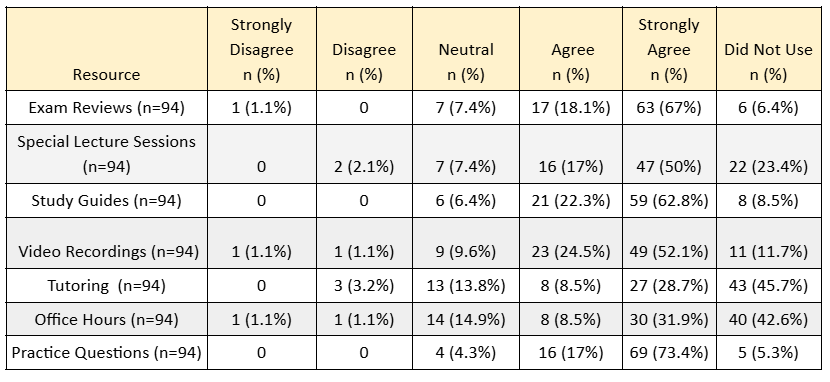
Students generally found the supplemental resources extremely helpful for exam preparation and preferred asynchronous resources (study guides, practice questions, and video recordings) over synchronous resources (exam reviews, special lecture sessions, office hours, and tutoring appointments). Figure 1 highlights the supplemental modalities used by first-year students in 2022, and Figure 2 illustrates the top three supplemental resource modalities students found most helpful. Table 1 shows how students rated the helpfulness of each resource on a five-point Likert scale and could indicate if a resource was not used. Many students reported that exam reviews, practice questions, and study guides were the most helpful for exam preparation. Although video recordings were used and well received, they were less popular. Additionally, many did not take advantage of tutoring, office hours, or special lectures. These results suggest that students prefer and engage more positively with asynchronous resources. Notably, exam review sessions were the most utilized resource and ranked highest among students’ top three supplemental modalities despite being a synchronous format. One possible explanation is that students considered exam reviews to be high-yield content that supported their exam preparation.

Figure 1. Supplemental Instruction Methods Utilized by P1 Students

Figure 2. Top Three Helpful Supplemental Instruction Modalities According to P1 Students.
Table 1. Helpfulness of Supplemental Resources as Perceived by P1 Students Using a 5-Point Likert Scale
Call to Action
This analysis does not definitively identify the most helpful resource; however, it does highlight the value of asynchronous supplemental materials as accessible learning tools, and that exam reviews are a beneficial synchronous option. While these results are only from a single course of first-year pharmacy students, future research can investigate if similar trends emerge across different pharmacy school courses and years of the professional curriculum.
What supplemental education materials have student pharmacists found beneficial at your institution?
References:
- Aburahma MH, Mohamed HM. Peer teaching as an educational tool in Pharmacy schools; fruitful or futile. Curr Pharm Teach Learn. 2017;9(6):1170-1179. doi:10.1016/j.cptl.2017.07.026
- Lull ME, Mathews JL. Online Self-testing Resources Prepared by Peer Tutors as a Formative Assessment Tool in Pharmacology Courses. Am J Pharm Educ. 2016;80(7):124. doi:10.5688/ajpe807124
- Spivey CA, Davis MS, Rodriguez JD, Havrda D, Chisholm-Burns MA. Effects of peer-led study sessions on first-year student pharmacist performance in pharmacy math. Curr Pharm Teach Learn. 2021;13(9):1168-1173. doi:10.1016/j.cptl.2021.06.029
- Nwaesei AS, Liao TV. A Programmatic Approach to Peer-Led Tutoring to Assist Students in Academic Difficulty. Am J Pharm Educ. 2023;87(1):ajpe8726. doi:10.5688/ajpe8726
- Buring SM, Williams A, Cavanaugh T. The life raft to keep students afloat: Early detection, supplemental instruction, tutoring, and self-directed remediation. Curr Pharm Teach Learn. 2022;14(8):1060-1067. doi:10.1016/j.cptl.2022.07.018
Author Bio(s):

Collin Blackwell is a P4 student at The University of Texas at Austin College of Pharmacy. Collin’s educational research interests include peer-assistance learning and active learning in didactic and experiential education. In his free time, Collin enjoys learning new recipes to build his cooking skills, learning to advance his technology skills, and listening to educational podcasts.
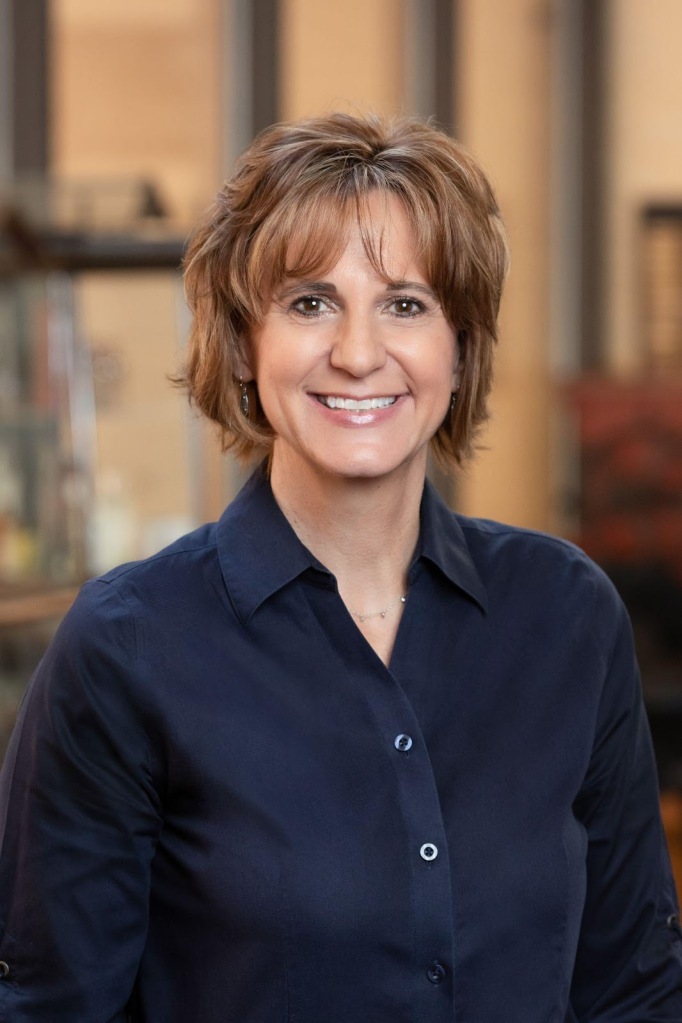
Renee Aocsta is the Senior Associate Dean for Academic Affairs and Clinical Professor at The University of Texas at Austin College of Pharmacy. Renee’s educational scholarship interests include factors that impact pharmacy school admission, and student progression and academic success. In her free time, Renee’ enjoys reading, attending concerts, and spending time with her family.
Pulses is a scholarly blog supported by a team of pharmacy education scholars.
 Pulses
inspiring! 67 2025 What is Better? Asynchronous vs. Synchronous Supplemental Resources in Pharmacy Education: Peer-Teaching Perspectives likable
LikeLike