
By Emily Eddy, PharmD, MSLD, BCACP and Jennifer Mazan, PharmD
Today’s pharmacists are practicing in an environment unlike any before. Patients no longer rely solely on healthcare professionals for health information; instead, they are exposed to a constant stream of content from social media, online influencers, podcasts, websites, and artificial intelligence tools. 1,2 While access to information has never been greater due to the digital age, it has become increasingly more difficult to combat the spread of misinformation. Healthcare misinformation can be harmful in multiple ways, including harm to the patient, erosion of trust in evidence-based science, and detriment to the clinician-patient relationship. 1
As a result, addressing medical misinformation has become a persistent challenge across all healthcare disciplines. Since pharmacists are among the most accessible healthcare professionals, they increasingly find themselves on the front lines of an “infodemic”, an environment inundated with misinformation that is often more persuasive than evidence-based recommendations. 1-4 Combating misinformation requires more than medication expertise and accessibility. It requires effective communication that is patient-centered, builds trust, navigates emotion, and is with empathy and respect.
For pharmacy educators, this reality presents an important challenge and opportunity: Are we adequately preparing students for these difficult conversations?
Traditional pharmacy curricula place significant emphasis on developing students’ ability to evaluate scientific literature, interpret clinical guidelines, and apply evidence-based medicine. 1 These competencies are essential, but knowing the evidence and communicating the evidence are two very different skills.
When pharmacists respond to misinformation by simply presenting data or correcting inaccuracies, they may unintentionally create resistance rather than understanding.1-4 Patients rarely make healthcare decisions based solely on the data. Their choices are also influenced by personal experiences, cultural beliefs, family values, and emotions. 2 To communicate effectively, future pharmacists must learn to acknowledge concerns, explore beliefs, and build relationships while still using evidence-based recommendations.
Communication Frameworks
Several communication frameworks exist that can help pharmacy students navigate conversations about misinformation while maintaining trust and professionalism (Figure 1). 1-4
Figure 1. Existing Communication Frameworks 1-4
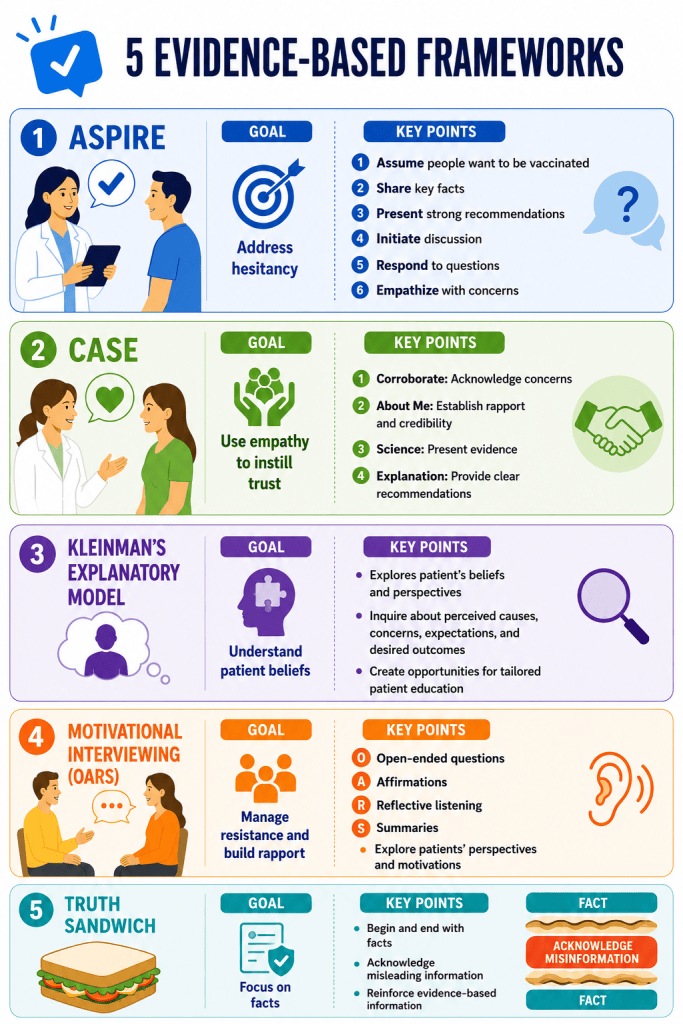
Currently, no comprehensive framework exists to address the full range of communication skills required to address medical misinformation. The following proposed framework incorporates aspects of several existing frameworks. The proposed framework is intended to equip learners with the competence and confidence to engage effectively in difficult conversations with patients about misinformation.
Table 1. New Proposed Framework – TRUST
| TRUST Framework | Goal | Reference to Other Communication Models |
| Tune In | Listen to learn the patient’s beliefs, thoughts, and life experiences Use open-ended questions to learn more | Kleinman’s Explanatory Model 1, 4 Motivational Interviewing 1,3,4 |
| Recognize and Validate | Build trust Allow patient to feel comfortable and open to discussion | CASE – corroborate1,3,4 ASPIRE – assume and empathize 4 |
| Understand hesitancy | Do not diminish concerns, but seek to understand where they originated Keep communication patient-focused | Kleinman’s Explanatory Model 1,4 Motivational Interviewing 1,3,4 ASPIRE – initiate 4 |
| Share evidence | Share evidence tailored to specific patient concerns Present evidence in layman’s terms | CASE – about me and science 1,3,4 ASPIRE – share and present 4 |
| Tell the Truth | Respect patient’s beliefs while providing evidence-based recommendations End conversation with reinforcement of clinical facts | Truth Sandwich 1,4 |
Call to Action – Modernizing Communication Training
Effective communication in the age of misinformation requires more than just mastering a structured framework. It requires students to develop strategic communication skills that emphasize trust-building, active listening, and empathy. The TRUST Framework fosters these skills by guiding students to first establish trust and understand the patient’s perspective. Students are then better equipped to communicate evidence respectfully and empathetically while acknowledging existing beliefs.
Communication training is a core competency essential for patient care, as stated in ACPE Standard 2.1.c and should be woven throughout the curriculum. Educational approaches should continue to move beyond traditional didactic instruction and incorporate active-learning strategies. Research indicates that role-playing exercises and structured debriefing sessions enhance students’ confidence and ability to manage difficult conversations. 3,5 Projects such as assessing social media content for validity, developing evidence-based social media content, identifying deceptive advertising, and understanding the limitations of AI will provide students with opportunities to critically evaluate health information beyond peer-reviewed literature and practice communicating this information with a patient.1,3
Students may begin pharmacy school with preconceived beliefs shaped by medical misinformation, often without recognizing that these beliefs are inaccurate or unsupported by evidence. Challenging and replacing these misconceptions can be difficult. Faculty should intentionally prepare learners to critically evaluate health information, identify misinformation, and develop the skills to effectively communicate the evidence effectively and with empathy. By modernizing communication skills training and frameworks, pharmacy educators can equip the next generation of pharmacists to serve as trusted sources of evidence, strengthen patient relationships, and protect patient health in an era defined by information overload and misinformation.
What communication strategies are you teaching students to combat medical misinformation?
Notebook LM was used to generate infographic and the initial draft of the table.
References:
- Covvey JR, Harpe SE. Dispensing The Truth: The Need to Educate Future Pharmacists to Counter Health Misinformation. Am J Pharm Educ. 2025;89:101874. doi:10.1016/j.ajpe.2025.101874
- Goldwire MA, Johnson ST, Abdalla M, et al. Medical misinformation: a primer and recommendations for pharmacists. J Am Coll Clin Pharm. 2023;6(5):497-511. doi:10.1002/jac5.1760
- Johnson ST, Goldwire MA, Abdalla M, et al. Teaching learners to identify and reduce the spread of medical misinformation. J Am Coll Clin Pharm. 2024;7(9):926-940. doi:10.1002/jac5.2014
- Harris IM, Hilaire ML, Jeon M, et al. Pharmacists’ role in combating medical misinformation. J Am Coll Clin Pharm. 2024;1-5. doi:10.1002/jac5.2005
- Bourgault A. Strategies to identify and navigate misinformation. Crit Care Nurse. 2025;45(5):4. doi:10.4037/ccn2025588

Dr. Eddy is an Assistant Professor and Director of Labs and Simulations at Texas Tech Jerry H. Hodge School of Pharmacy in Dallas. Her educational scholarship interests include layered learning, simulation, and lab-based SoTL. In her free time, Emily enjoys spending time with her family and friends, as well as trying new coffee shops around town.
Jennifer is a Professor of Pharmacy Practice at Midwestern University College of Pharmacy, Downers Grove Campus. She serves as the course director for several skills-based courses and is committed to ensuring students master the skills required for IPPE and APPE rotations. Scholarly interests include the development of effective teaching methods and assessments for various pharmacy skills, including patient counseling. In her free time, she enjoys painting and spending time with her husband and adult children.
Pulses is a scholarly blog supported by a team of pharmacy education scholars

